




HOME |
NEWS |
CONFERENCE |
DAI |
LINKS |



Supported by:

Initiating effective transboundary conservation_cover
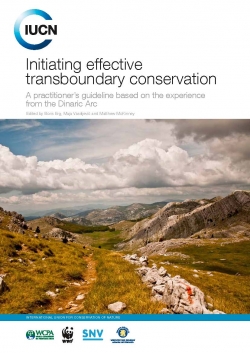
A new publication by IUCN shows how transboundary conservation action in South-East Europe’s Dinaric Arc helps protect the region’s rich biodiversity and introduces an innovative tool which helps develop cross-border partnerships.
The new book, Initiating effective transboundary conservation: A practitioner’s guideline based on the experience from the Dinaric Arc, highlights examples of cooperation across borders in the Dinaric Arc area – a region in South-Eastern Europe stretching from Trieste, Italy to Tirana, Albania and covering large areas of Slovenia, Croatia, Bosnia and Herzegovina and Montenegro. It shows how this approach to conserving nature has advanced the region’s unity in terms of conservation and sustainable development, while strengthening regional partnerships.
“Transboundary conservation is a long-run race which requires a lot of dedication, goodwill and mutual understanding. In return, it can bring clear and concrete results which go far beyond nature conservation,” says Boris Erg, Director of IUCN South-Eastern Europe and a co-editor of the book.
The new diagnostic tool presented in the book is an innovative way of assessing feasibility of transboundary conservation and can be applied to various ecosystems and geographical regions worldwide. Its key advantage is that it can be completed by anyone interested in initiating transboundary cooperation, not only conservation experts.
“The diagnostic tool assists planners of transboundary conservation processes in carefully diagnosing the situation by assessing the need and readiness to initiate a transboundary process, while not neglecting opportunities and risks,” said Maja Vasilijević, Chair of IUCN World Commission on Protected Areas Transboundary Conservation Specialist Group and a co-editor of the publication.
Transboundary conservation helps people work across state boundaries to conserve nature. It brings large-scale ecological benefits by protecting extensive natural areas, supporting species migrations and reducing the risk of biodiversity loss. It is an effective way of promoting cooperation and forging partnerships across borders: it encourages former enemies to start talking, generates joint income opportunities, and helps resolve political conflicts.
“By initiating transboundary collaboration, we give ourselves an opportunity to base sustainable development on the fantastic natural and cultural values, while at the same time greatly improve the image of the entire region,” said Deni Porej, Director of Programs at WWF Mediterranean.
Piloted in several key nature sites in the Dinaric Arc area, transboundary conservation has proved to be an effective way for establishing dialogue and a shared vision. On the basis of shared natural resources six Memoranda of Understanding have been signed across the region, leading to the definition of conservation priorities and joint action plans. Transboundary hiking trails, signposting, educational and communication material are some of results stemming from improved dialogue across borders.
Initiating effective transboundary conservation: A practitioner’s guideline based on the experience from the Dinaric Arc was edited by Boris Erg, Director of IUCN South-Eastern Europe, Maja Vasilijević of IUCN World Commission on Protected Areas Transboundary Conservation Specialist Group and Matthew McKinney of the Center for Natural Resources & Environmental Policy, University of Montana. It was published by IUCN and developed jointly by IUCN World Commission on Protected Areas’ Transboundary Conservation Specialist Group, WWF Mediterranean Programme, and SNV Netherlands Development Organization.
The publication is available here
The “Diagnostic tool for transboundary conservation planners: Suggested questions to determine feasibility for transboundary conservation” consists of 91 carefully selected questions to help protected area authorities, governments, non-governmental organisations (NGOs), local communities, and other interested parties in determining the need for transboundary conservation approach, readiness of stakeholders to engage in the process, multiple opportunities that could either fasten and/or be generated by the process, and the risks that could hinder the process.
This practical tool also includes a report which is automatically developed while completing the questionnaire. The report provides a set of guiding principles on the most urging issues relevant for initiating a transboundary conservation process, e.g. the compelling reason(s) for undertaking a transboundary approach, capacity status and needs of key stakeholders, opportunities and risks in a number of thematic areas.
The diagnostic tool was developed by Maja Vasilijević, Chair of WCPA TBC SG, in consultation with Boris Erg, Director of IUCN Programme Office for South-Eastern Europe, and members of the TBC SG, with technical support in designing the scoring methodology by Eco Horizon NGO from Croatia. It was initially developed for the purpose of a new publication by IUCN and its partners, WCPA TBC SG, WWF Mediterranean Programme, and SNV Netherlands Development Organization, “Initiating effective transboundary conservation: A practitioner’s guideline based on the experience from the Dinaric Arc”, a volume edited by Boris Erg (IUCN), Maja Vasilijević (WCPA), and Matthew McKinney (University of Montana).
Download the Diagnostic tool for transboundary conservation planners here.
We are pleased to announce DINARIC ARC PARTNERSHIP BREAKFAST on the issue of the presenting results of the project “Environment for the People in the Dinaric Arc”.
With a courtesy of the Faculty of Biology the breakfast will be served at Botanical Garden Jevremovac (Takovska 43, Belgrade ) on Tuesday, the 19th of June 2012, starting at 10.30 a.m.
Detailed agenda is enclosed.
To confirm your participation, please RSVP to Emira Mesanovic Mandic, [email protected]
Let us share with you our know-how and experience on transboundary collaboration!
Emira Mesanovic Mandic
Transboundary Collaboration Programme Manager
WWF MedPo
+381 61 638 66 33
The meeting on the topic of future Transboudary Biosphere Reserve Drina was organized on Friday, June 8th, 2012.
The meeting hosted school teachers and school directors from the surrounding municipalities: Srebrenica, Pecka, Pribojska Banja, Mačkat, Bajina Bašta, Ljubovija, Valjevo, Skelani, Kravica, Sirogojno, Bratunac, Novo Goražde.
The main purpose of the event was to promote material prepared within the Action plan for „NP Tara/Drina“ site including educational tools for pre-school and school children. The educational tools were prepared in partnership between Tara National Park on the Serbian side and the Republic Institute for the Protection of Natural, Cultural and Historical Heritage from Republic Srpska BiH.
This event was organized in the framework of the”Cultural Days” in Srebrenica municipality, and hosted by the National Library of Srebrenica.
Mrs. Marijana Josipovic, associate from Tara NP and Ms. Radana Turjacanin, associate from the Institute for the Protection of Natural, Cultural and Historical Heritage of the Republic of Srpska, presented the main characteristics of the region and Biodiversity values, as well as information on purpose of the educational material.
At the end of the meeting the material was delivered to school teachers.
This commemorative event was launched by the EUROPARC Federation in 1999 to celebrate protected areas throughout Europe. It aims at bringing people closer to nature and raising public awareness on the importance of the natural beauty preserved in protected areas and the importance of conservation and sustainable management of those places.
`See the sky. Touch a tree. Feel the air. Find yourself´.
This year´s motto was simple and individualistic, and intends to inspire people to enjoy and appreciate the natural treasures in their own country and all over Europe.
A little bit of atmosphere from celebration of European Day of Parks from our NPs (supported by "Environment for People in the Dinaric Arc project"):
NP Tara
http://www.nptara.rs/sr/home/…
Hutovo Blato
www.hutovoblato.com
National Park Una
http://nationalpark-una.ba/bs/vijest.php?id=64/DANEVROPSKIH PARKOVA U NP UNA
NP Durmitor
www.nparkovi.me/aktuelno/259-obiljeen-dan-evropskih-parkova
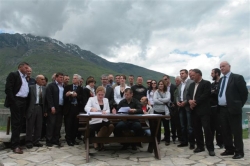
Memorandum of Understanding signing in Plav, MNE by IUCN/T.Pezold
Common understanding for sustainable development in the border region of Prokletije/Bjeshkët e Namuna Mountains was officially announced on 8 May 2012, when Local Action Groups (LAGs) of Albania and Montenegro signed the Memorandum of Understanding (MoU), agreeing to strengthen the cooperation in environmental protection, tourism and recreation.
The MoU concerns mountain range of Prokletije/ Bjeshkët e Nemuna Mountains that straddles the border between Albania and Montenegro. This pristine ecosystem is characterised by high biodiversity, rich local tradition and unique cultural values. Its magnitude places it at the top of the list of largest unspoilt natural areas of Europe. Yet, the region is facing inadequate management practices, ever increasing pressure caused by uncontrolled development, low public participation in management practices, lack of efficient communication and the understanding of biodiversity values and its benefit for the local communities.
This MoU is not a common transboundary agreement given that it is signed between Local Action Groups consisting of representatives of local authorities, stakeholder groups and individuals. Unlike national or regional authorities, the LAGs do not have statutory powers of their own and therefore cannot require any particular action to take place. The MoU is not legally binding in anyway and its articles are not obligatory. The LAGs must rely on campaigning, persuasion, lobbying, information sharing, cooperation and consensus building to achieve their aims. This MoU provides a framework for such actions. Although a strong level of cooperation between the LAGs is hoped for, this is inevitably limited by logistics, available resources, capacities and language differences. Though, having in mind the enthusiasm and support from all actors involved, the prospects for future cooperation and sustainable development of this area are promising.
The MoU is supplemented with Guidelines that explain its articles and suggest Local Action Groups the ways to implement them in their own countries and to collaborate on their realization across the border. It has been signed within “Environment for People in the Dinaric Arc” project implemented by IUCN (International Union for Conservation of Nature), WWF Mediterranean Programme and SNV (Netherlands Development Organization) funded by the Ministry of Foreign Affairs of Finland.
Training participants by IUCN/V.Ferdinandova
Conservation programs can be successful and effective only if relevant and supported by the citizens. This is what conservation experts increasingly recognize and try to bring up higher in their agenda. Earlier this year IUCN and Quebec-Labrador Foundation/Atlantic Center for the Environment held a training on the civic engagement in nature conservation. It was organized in Knin, Croatia, within the Environment for People of the Dinaric Arc project.
The purpose of the training was to introduce to participants from the cross-border project sites of the Dinaric Arc region the idea of civic engagement in natural recourse management and inspire them to take responsibility for the environment they live in. The training stressed out the potential benefits of civic engagement, proving it to be a valuable approach to sustain rural communities and their traditional landscapes in transboundary protected areas. It provided representatives of the civil society, national parks’ administration, municipalities and local communities with successful methods for civic engagement, such as facilitation, communication, consultation, idea generation, prioritization, collaboration, and personal connection to natural landscapes. Participants learned about the examples of civic engagement in protected landscape areas from other regions in the world such as North America where this is frequently used method.
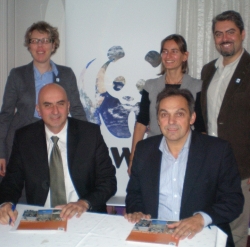
From left to right, Ms. Duska Dimovic WWFDCP, Mr. Boban Tomic NP Tara, Mr. Goran Milojevic RIPCHNH, Ms. Veronika Ferdinandova IUCN, Mr. Deni Porej WWFMedPo, by WWF.
Partnership between the National Park Tara from Serbia and the Republic Institute for Protection of Cultural, Historical and Natural Heritage Banja Luka, Bosnia and Herzegovina was formally announced on 16 November 2011. The directors of these two institutions dedicated to the preservation of biodiversity signed a Memorandum of Understanding in which they pledge to develop and implement cross-border activities on common strategic fields. Judging from the activities under this Agreement, Serbia and Bosnia and Herzegovina may soon have the first Transboundary Biosphere Reserve, which would extend on the territory of 6 municipalities: Visegrad, Srebrenica, Rogatica in BiH and Užice, Čajetina, Bajina Bašta in Serbia.
Cross-border cooperation is a prerequisite for the systematic and long-term biodiversity conservation and community development based on sustainable use of natural resources.
Memorandum of Understanding was signed within the project "Environment for people in the Dinaric Arc" that is being implemented by the IUCN (International Union for Nature Conservation), WWF MedPO (World Wide Fund for Nature Mediterranean Program) and SNV (Netherlands Development Organization), and funded by the Ministry of Foreign Affairs of Finland.
 Local Action Group Bjeshket e Namuna_leaflet The Chestnut Day summary
The Chestnut Day in Tropoja, organized on 23 October by local action group Bjeshket e Nemuna, gathered ministries’ representatives and local stakeholders aiming at promotion of chestnut through the scientific exchange. The vivid discussion tackled topics such as the future role of the LAG in the sustainable economic development of the area, or particular values of chestnuts of Tropoja and its economic potentials.
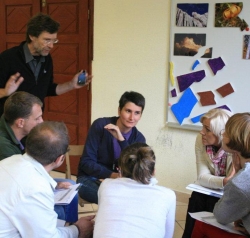
IUCN PA management categories training_working groups by IUCN/T.Pezold
The workshop’s main objective was to improve understanding on IUCN protected area definition, the differences between the six IUCN PA categories as well as the importance on assigning IUCN PA categories for the global protected areas network. The steps of assigning PA categories were exercised by participants indoor but also during a field session demonstrating examples from the area of Velebit mountain.
“The role of protected areas is continuing to evolve” says Nigel Dudley, IUCN WCPA expert. “While in the beginning they were mainly chosen because of their aesthetic and recreational values, in the course of time their importance for wildlife, biodiversity and later for ecosystems services they provide has been increasingly recognized.
When thinking about the objectives of a protected area we need to keep in mind four elements: socio-economic and political context; natural values; other values such as cultural and economic, as well as threats to the area. In some cases the management objective would be quite straightforward - the areas don’t need management and should be left on their own, while in others the difficult process of identifying and negotiating the crossing points between use and preservation needs to take place between different stakeholders.
The governance of the PAs in Western Balkans is mainly centralized in the governmental institutions while community managed and private protected areas are rather an exception. Although the general trend is towards increasing the total protected area, there are places where the opposite process appears to be the case due to prevailing non-conservation interests. The region of Dinaric Arc still holds the rare opportunity of designating new protected areas, even big ones such as national parks– a chance most of the other European countries have used up by now one way or another.
The workshop opened with welcoming remarks from Milan Nekic, Director of NP Sjeverni Velebit and Davorin Markovic, Director of the State Institute for Nature Protection in Croatia – the two organizations generously supporting the event with bright ideas, professional advice, logistics and traditional local sound.
The training was organized within Environment for People in the Dinaric Arc project financially supported by the Finnish Ministry for Foreign Affairs and held by IUCN WCPA experts Nigel Dudley and Sue Stolton.
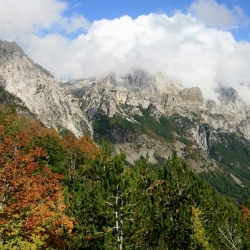
Prokletije Mountains by IUCN/T.Pezold
Workshop introduction EU Policies and opportunities supporting protected areas Assessment of biodiversity areas European Green Belt Principles of TB conservation Tourism and protected areas Tourism and recreation in protected area Managing protected areas Protected areas in a changing world Triglav National Park Slovenia_experienceThe training was given to Local Action Groups (LAGs) members from Albania and Montenegro residing in the area of potential three lateral transboundary protected area of Bjeshkët e Namuna/Prokletije Mountains. Based on practical experiences, the participants were introduced to modern transboundary protected areas concepts and approaches with an emphasis on governance, management, financing, administration and tourism. Lively discussions in work groups resulted in valuable feedback which will be further utilized to set basis for transboundary cooperation agreement between the two LAGs.
The training was led by IUCN’s World Commission on Protected Areas (WCPA) members – Michael R. Appleton, Alois Lang (Public Relations and Ecotourism Department of Neusiedlersee-Seewinkel National Park, Austria), Martin Šolar (Director of Triglav National Park, Slovenia) with the contribution of IUCN Secretariat and local experts. The training was organized in the frame of “Environment for People in Dinaric Arc” project implemented jointly by IUCN, SNV and WWF, and financed by the Ministry for Foreign Affairs of Finland.
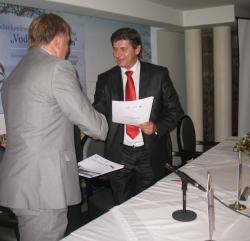
Director of NP Una Mr. Mulic and director of NP Plitvice Lakes Mr. Sutic by SNV/G.Bojic
The Memorandum of Understanding specifies main areas of cooperation, namely protection and preservation of natural and cultural values, improvement of governance and institutional development, as well as sustainable development of the entire region. Further development of sustainable tourism in both national parks and transfer of knowledge and experience between two protected areas are recognized as priorities. The document also includes measures to achieve the set goals, such as: preparation of a registry of natural values for NP Una, establishment of a system for planning and information, fundraising for nature protection, harmonization of management objectives of NP Una with a nature protection and preservation ones in NP Plivice Lakes, organization of transfer of knowledge and examples of good practice between the parks, organisation of trainings for developing a quality government body in NP Una, etc.
Directors of the national parks Una and Plitvice Lakes, Mr. Amarildo Mulic and Mr. Branislav Sutic respectively, addressed the audience and emphasized the necessity and need for mutual cooperation in preserving the common values of the national parks. The Minister of Federal Ministry of Environment and Tourism of Bosnia and Herzegovina Ms. Branka Djuric, gave full support to efforts to establish cross-border cooperation. The next step is action planning, which includes defining of joint cross-border activities that will be carried out by two partner national parks and will be entirely or partially financed by project means.
The signing took place after an extensive discussion during a stakeholder meeting held beginning of July followed by bilateral consultations between the two parks and facilitated by the project team. The signing event was attended by more than 50 guests among which representatives of Bihac and Plitvice Lakes municipalities, high officials of Lika-Senj County and Una-Sana County from Croatia and BiH, Director, Chairman of the Board and representatives of the PE “Una National Park”, Director and Assistant Director of development agencies of Una-Sana Canton and Lika-Senj.
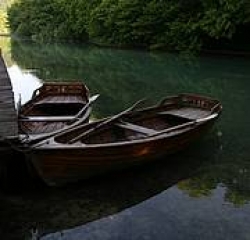
NP Plitvice - Two boats by IUCN/B.Erg
Implementation of actions is something we are all eager to do because it gives tangible results and brings about fulfillment. However, in order to be consistent and effective these actions should be based on a long term vision. Mentioned two parks are one of Environment for People in the Dinaric Arc project cross border sites and as soon as Una National Park, designated three years ago, appointed a director a step towards official cooperation was undertaken. This is not the first time institutions from the border area in the two countries agree on collaboration for joint development but is the first time when an agreement for protection of the nature in the region is being discussed.
Amongst the senior local officials such as the mayors of Bihac and Plitvice Lakes, vice president of Lika-Senj county, chairman of the Advisory Board of Una NP, representatives from the Croatian and BiH ministries as well as the newly appointed minister of the Ministry of Environment and Tourism of BiH also attended the meeting.
As Plitvice Lakes NP is a world famous World Heritage Site and receives a million tourists every year, development of sustainable tourism, not surprisingly, came out as priority for cooperation. However, the Director of the Institute for Nature Conservaiton of Croatia Mr Davorin Markovic emphasied that „tourism development can only be based the existing nature values of the region. Therefore the cooperation between the parks should first and foremnost be laid in the field of presereving biodiversity“. The same message was clearly communicated by Ms Antonija Dujmovic, a conservation manager in Plitvice Lakes NP- “Keep unspoiled your nature. Whether you receive tourist now or later does not matter so much, what matters is to keep the basis for your development unspoiled”.
As a follow-up of the meeting actions will be identified and selected ones implemented within the frame of the project.
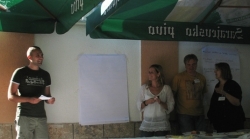
Training participants by IUCN/V.Ferdinandova
Tourism’s high potential is seen as not-to-miss opportunity for development of the Dinaric Arc where the appearance of natural and cultural diversity often goes beyond the imaginable. However, only good management planning can secure tourism sustainability providing both social and environmental benefits. In order to educate protected areas managers, tourism organizations and local authorities how to avoid rampant ad hoc tourism growth, the IUCN-led project “Environment for People in the Dinaric Arc” organized a training on sustainable tourism development in the cross-border areas in Dinaric Arc at the end of June. The training covered topics such as establishment of cross-bored cooperation, building common vision and objectives including what makes a place unique not only for locals but also for potential customers. Once the planning is done in a proper manner and the tourist flow is on the way it is not time for sitting down, another important job is to be done - selecting indicators and measuring sustainability, monitoring the impact of tourism and undertaking corrective actions as necessary. Still it is important to remember that tourism per se is not a panacea for local development and not every place holds tourism potential. The manual on this topic will be elaborated and published in the autumn.

European tree frog (Hyla arborea) by Provincial Institute for Nature Conservation (Serbia)/V.Dobretic
IUCN Red List leaflet March 2011 (Ser) IUCN Red List training workshop_conclusions (Ser)The training was organized in March 2011 for scientists involved in species data collection and analysis from Serbia, Bosnia and Herzegovina, Montenegro, Croatia and FYR of Macedonia. It was conducted by Rebecca Miller, Programme Officer, IUCN Red List Unit and Ana Nieto, Regional Biodiversity Conservation Officer, IUCN Regional Office for Europe. Participants improved their general understanding on what the Red List is, how it is compiled and by whom; learned how to produce high-quality assessments and how to apply the IUCN Red List Categories and Criteria, and understood clearly the Red List terms and definitions. Dr Ivica Radovic, State Secretary of the Ministry of Environment of Serbia stressed out the importance of the synergy of knowledge this training offers. “The training was aimed at providing experts with better understanding of the IUCN Red List and to support further development of national Red Lists in South-Eastern Europe” - Boris Erg, Director of IUCN’s Programme Office for South-Eastern Europe added. The training was supported by the Ministry for Foreign Affairs of Finland.
The IUCN Red List of Threatened Species™ is the most authoritative source of information on the conservation status of species in the world. It uses a set of precise criteria to evaluate the species risk of extinction of species thus assigning them one of the eight categories of threat. By knowing which species are more “in need” of protection, the red list categorization can help our decision on where to invest more conservation efforts. On the other hand it provides a benchmark against which to measure the effectiveness of conservation actions.
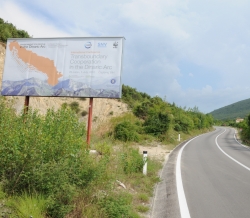
The Dinaric Arc - Transboundary Cooperation by IUCN/B.Erg
The event took place 29 June - 1 July 2010 in Capljina, BiH, in the vicinity of one of the project sites – Hutovo blato Nature Park part of the Neretva Delta. Results from the assessments, analysis and stakeholder meetings completed in the target project areas revealed not only opportunities, but also the weaknesses and challenges for cross-border cooperation and protected areas. The conference provided food for thought on the way forward for improved cross-border environmental governance.
The assessments once again showcased the high natural and cultural values of the region- the main assets of the Dinaric Arc. Well preserved natural features and a diverse cultural heritage along, with minor language barriers offer excellent potential for the development of cross-border cooperation. In terms of relations currently established between protected area managers, local authorities and communities, the picture differs significantly from site to site. Thus for example Plitvice Lakes and Una national parks in Croatia and BiH respectively are not spatially connected and what is even more crucial - dialogue to lead to effective cooperation and joint activities between the two parks is still missing. Similarly, close to the border but without adjacent edges are Durmitor and Sutjeska national parks in MNE and BiH but unlike Plitvice and Una, they have signed an MoU and extensions of the two national parks towards the border are included in the spatial plans of both countries.
“Aligning priorities for joint actions now, based on the results of the assessments and the stakeholder processes will lead to considerable achievements on the ground thus ensuring a long-lasting conservation of biodiversity and effective support to local livelihoods”, said Boris Erg, Director of IUCN’s Programme Office for South-Eastern Europe.
In terms of existing capacity some sites have well established operational protected area authorities while others are only starting to develop management capacity and know-how. For sites like Dinara Mountain and Drina River on the Bosnian side, designation of PAs is still in the pipeline and it will take longer before genuine cooperation is in place. Environmental problems throughout the region are also not an exception. Sometimes inconsistent state policies, not only between different states but also among different sectors within one country, are questioning sustainable use and fair sharing of resources.
Providing a concise overview of major transboundary concepts in nature conservation, Maja Vasilijevic, Chair of the Transboundary Conservation Specialist Group of WCPA stressed that “A transboundary park is not only about straddling borders to protect biodiversity but also about cooperative management”. Excellent examples of management including common research, monitoring and databases as well as conservation actions and promotion of common resources was given by Europe’s wild Heart – Sumava and Bavarian Forests national parks - for which it holds EUROPARC’s certificate for transboundary cooperation. The latter is a result of a comprehensive analysis on the progress of trans-boundary cooperation conducted by EUROPARC Federation and proved to be an effective tool encouraging best practices and facilitating cooperation.
In the region of the Mediterranean, nature and culture are intimately interlinked and their coexistence dates back over two thousand years. Apart from having large cultural and historical sites, the region hosts small cultural segments in the landscape related to local traditions and practices. Such a combination of nature and culture expresses higher tourism potential and is one reason why generating income from tourism is seen as one of the best perspectives for economic development of the region. It should be kept in mind though that developing this sector is a long and expensive process that requires careful interventions to steer it in order to secure true improvement of people’s livelihoods.
Two years after the Big Win statement already 50% of the commitments made by the signatory states are achieved by designation and extension of protected areas such as National Park Una in Bosnia and Herzegovina, National Park Prokletije in Montenegro and National Park Shebenik in Albania.This once again shows the great potential and opportunities for the sustainable management of cross-border areas in the Dinaric Arc.
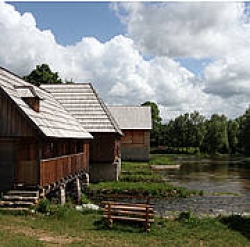
Dinaric Arc in Croatia by IUCN/B.Erg
Diversity, both cultural and natural, is what makes the Dinaric Arc region so special. Stronger cooperation across borders and shared actions will ensure the future of this diversity. In order to achieve this, six pilot sites were targeted and assessments conducted. Findings will be presented at the Conference opening the floor for discussion about the future development at the regional level.
The Project Environment for the People in the Dinaric Arc covers 6 pilot areas in 5 countries: NP Plitvicka jezera-NP Una, NP Durmitor-NP Sutjeska, NP Tara- Drina, Neretva delta, Mountain Dinara, and Prokletije/Bjeshkët e Namuna. The project is implemented by IUCN, WWF MedPO, and SNV with the financial support of the Ministry for Foreign Affairs of Finland.
The International Conference on Transboundary Cooperation in the Dinaric Arc is held from 29 June to 1 July 2010 in Capljina (BiH), and organized by IUCN (International Union for Conservation of Nature), WWF Mediterranean Programme, SNV Netherlands Development Organisation, and the Federal Ministry of Environment and Tourism of Bosnia and Herzegovina. At local level the conference will be hosted by the Municipality of Capljina and NGO “Lijepa nasa”.
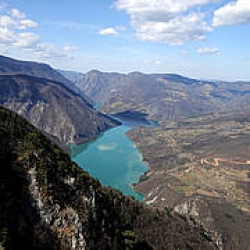
The Drina River (BiH/Serbia) by IUCN/B.Erg
The meeting, held in March 2010, gathered relevant state authorities, local communities, expert organizations, PA authorities, and NGOs from the bordering area along the Drina River in Bosnia and Herzegovina and Serbia in order to discuss actions to be taken to support transboundary cooperation in the target area. “This is an initial step towards the establishment of a transboundary protected area spanning Bosnia and Herzegovina and Serbia along the Drina River”, said Boris Erg, Director of IUCN Programme Office for South-Eastern Europe.
This is only one in a series of stakeholder meetings to be organized in selected transboundary areas of the Dinaric Arc in support of the establishment of a network of protected areas. Achievements so far comprise two Memorandums of Understanding signed between protected area authorities and NGOs in transboundary areas of Durmitor and Sutjeska National Parks as well as the Neretva River delta. The broad public participation process should end up with an international conference on the Dinaric Arc to be organized in June in Bosnia and Herzegovina.
The Dinaric Arc is a region of South-Eastern Europe encompassing a large part of the Western Balkans between the Adriatic Sea and the Danube Plain. The Dinaric Alps form the backbone of the region, which is endowed with a natural and cultural heritage with richness and variety that is almost unparalleled in Europe. The region hosts healthy populations of large carnivores, numerous endemic plant species, large and almost unspoilt forests, and is extremely rich in terms of freshwater ecosystems.
Yet, these qualities are under threat due to previous socio-political circumstances. Over the past twenty years, the countries of the Dinaric Arc have experienced periods of political and social instability, economic crisis and transition towards a market economy and European integration. Effects of rural abandonment and degradation of the natural environment have severe impacts on the livelihoods of many rural communities in the region. However, recent favourable events have created a unique opportunity to boost biodiversity, landscape conservation and sustainable rural development in the Western Balkans.
Therefore, IUCN has partnered with WWF Mediterranean Programme Office and SNV in order to foster the sustainable development of rural communities on the basis of conservation of biological diversity and traditional landscapes in transboundary areas of the Dinaric Arc. The overall project objective is to promote sustainable development of rural communities through increased transboundary cooperation in the management and conservation of biodiversity and cultural landscapes. The whole endeavor is supported by the Ministry for Foreign Affairs of Finland.